
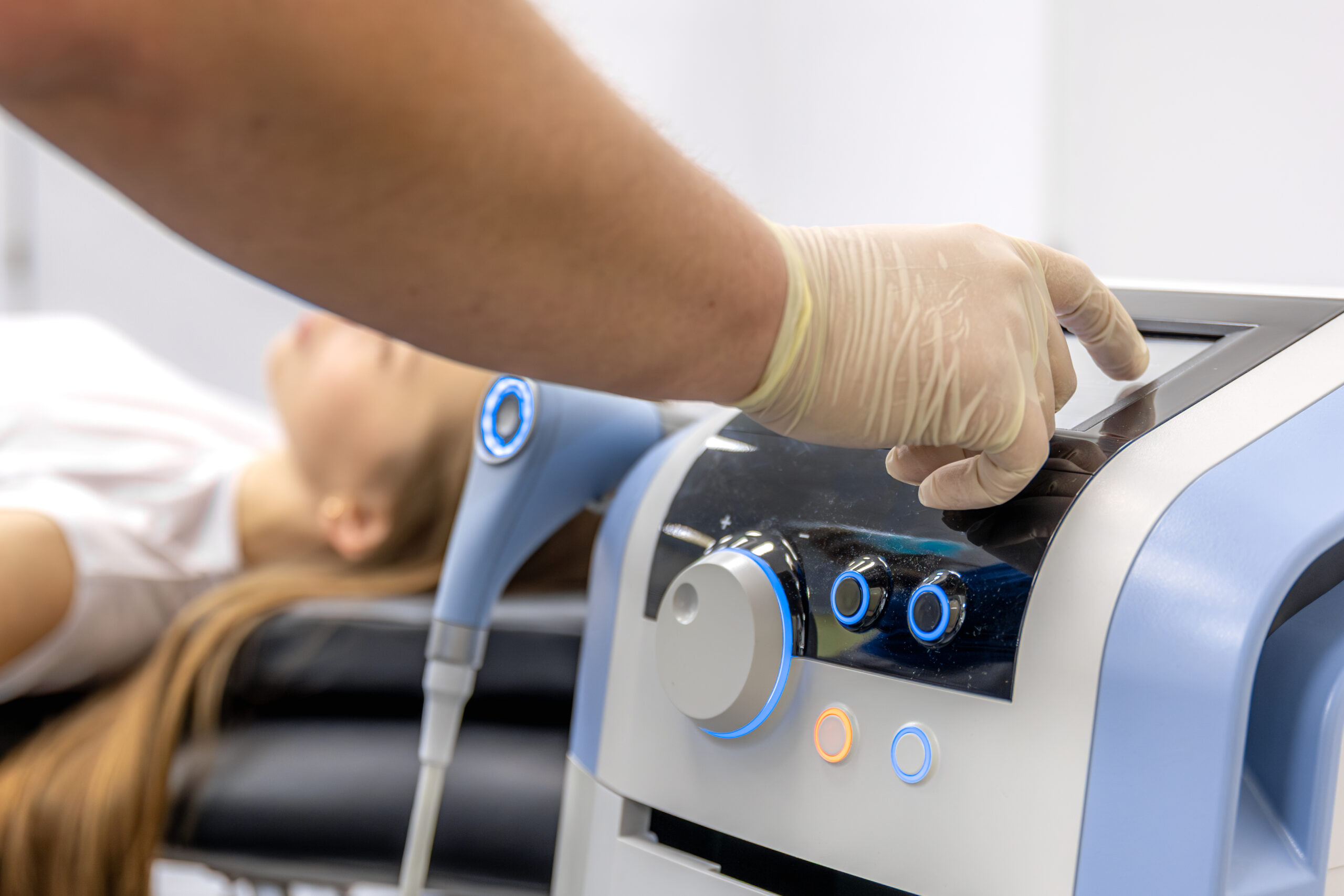
The Resume is a minimally invasive treatment for benign prostatic hyperplasia (BPH), also known as prostate adenoma. It uses water vapor to precisely destroy a portion of the prostate tissue responsible for urinary obstruction.
This technique can help improve urinary symptoms while limiting certain sexual side effects associated with more invasive surgical interventions.
How does Rezum actually work? Which patients is it for? What are its benefits and limitations, and how does it compare to prostatic artery embolization?
What is the Rezum prostate treatment?
Rezum is a technique that uses the thermal energy of water vapor to treat prostate tissues responsible for urethral obstruction.
During the procedure, a device is inserted into the urethra up to the level of the prostate. Small amounts of water vapor are then injected directly into the enlarged areas.
When steam comes into contact with prostate tissue, it releases its thermal energy and leads to the targeted destruction of the treated cells.
The body then gradually eliminates these tissues over the following weeks.
Therefore, the prostate does not decrease in volume instantly: The improvement is gradual..
In which cases can Rezum be offered?
Rezum treatment can be considered in certain men presenting with urinary symptoms related to benign prostatic hyperplasia.
These symptoms may notably include:
- a weak urinary stream; ;
- difficulty starting to urinate; ;
- a sensation of incomplete bladder emptying; ;
- frequent urges to urinate; ;
- urgent needs ;
- nocturnal awakenings to urinate; ;
- long or fractionated urination.
Rezum is particularly interesting for certain patients who wish to undergo an intervention while trying to preserve their sexual function and ejaculation.
What prostate size can be treated with Rezum?
The reference clinical study evaluating Rezum primarily involved men whose prostate volume was between 30 and 80 ml.
Other studies have since evaluated this technique in larger prostates.
However, the possibility of performing a Rezum procedure depends on several factors: prostate volume, the potential presence of a median lobe, prostate anatomy, the severity of the obstruction, and the patient's symptoms.
A prior urological evaluation is therefore necessary.
How does a Rezum procedure take place?
Rezum is performed endoscopically, through the urethra.
It therefore does not require an external surgical incision.
1. Introduction of the device into the urethra
The doctor introduces a specific instrument up to the level of the part of the urethra passing through the prostate.
2. Steam injection
A small needle is deployed into the prostatic tissue.
Steam injections are then performed in different areas of the prostate depending on its anatomy and volume.
Each injection takes only a few seconds.
3. Targeted destruction of prostatic tissue
The energy contained in the vapor diffuses into the tissue and causes controlled cellular necrosis.
4. Progressive reduction of the obstruction
Over the following weeks, the body gradually absorbs the treated tissue.
The pressure exerted on the urethra then gradually decreases, which facilitates urination.
How long does the procedure take?
The treatment itself is generally quick and can be performed in an outpatient setting.
Depending on the patients and the center's practices, different anesthesia or sedation methods may be offered.
The number of injections depends in particular on the volume of the prostate and the areas to be treated.
Do you need to wear a urinary catheter after a Rezum procedure?
A urinary catheter is frequently required after Rezum treatment, in particular due to the inflammatory edema temporarily caused by the treatment.
Its duration depends on the prostate volume, the patient's ability to urinate, and the possible presence of urinary retention before the procedure.
It can be maintained for several days.
In some patients, the post-operative period may also be accompanied by a temporary worsening of urinary symptoms before improvement begins.
When do you see the results of Rezum?
Rezum does not result in an immediate improvement.
The treated prostatic tissue must first be progressively absorbed by the body.
An improvement may appear during the first few weeks, and then continue to evolve for several months.
This particular feature must be taken into account when comparing Rezum to other BPH treatments.
How effective is Rezum?
Rezum now has multi-year follow-up data.
In the landmark randomized study of men with moderate-to-severe urinary symptoms and a prostate size of 30 to 80 ml, the observed benefits were maintained up to 5 years after the intervention.
At age five, the researchers notably reported:
- an IPSS score reduction of approximately 48 % ;
- an improvement in maximum urine flow rate of approximately 44 % ;
- a sustainable improvement in the quality of life; ;
- a surgical reintervention rate of 4,4 %.
These results show that Rezum can provide lasting improvement in properly selected patients.
Rezūm and sexuality: what effects?
The preservation of sexual function is one of the main benefits of the Rezum treatment.
Five-year follow-up data from the landmark clinical study showed no clinically significant impairment of erectile function attributable to the treatment.
Ejaculatory function is also generally better preserved than with certain endoscopic prostate surgeries.
However, this does not mean that the risk of sexual side effects is zero for every patient.
The initial situation, age, and other pathologies can also influence sexual function over time.
What are the possible side effects of Rezum?
Like any medical intervention, Rezum can cause side effects.
Most are temporary and related to inflammation caused by the treatment.
They may notably include:
- burning when urinating; ;
- a temporary increase in the frequency of urination; ;
- urgent urges to urinate; ;
- pelvic discomfort or pain; ;
- blood in the urine ;
- blood in the semen ;
- a urinary tract infection ;
- a temporary difficulty in urinating; ;
- urinary retention requiring a catheter.
Furthermore, improvement is not sufficient in all patients, and a new course of treatment may sometimes be necessary.
What are the limitations of the Rezum treatment?
Rezum has several advantages, but it is not necessarily the best solution for all BPH patients.
Progressive enhancement
Unlike a procedure that immediately removes a portion of the obstructing tissue, Rezum works gradually.
Several weeks may be necessary before observing significant improvement.
Urethral instrumentation
The treatment is carried out by introducing an instrument through the urethra.
This feature may be important for certain patients wishing to avoid any transurethral procedure.
The frequent use of a urinary catheter
A temporary urinary catheter is commonly used after the procedure.
Results depending on prostate anatomy
Prostate volume, morphology, and the location of the adenoma can influence the indication and the results.
A recurrence remains possible
As with other prostate-conserving treatments, symptoms may recur over the years and require a new treatment.
Rezum or prostate embolization: what are the differences?
Rezum and prostatic artery embolization are two minimally invasive approaches for treating certain BPH symptoms, but how they work is very different.
Rezum acts directly on the prostate
The device is introduced through the urethra and the steam is injected directly into the prostate tissue.
Embolization works through the arteries
Prostatic artery embolization is performed by an interventional radiologist.
A very thin catheter is inserted into an artery, usually at the wrist or groin, and then guided to the arteries supplying blood to the prostate.
Microparticles are then injected to selectively decrease its blood supply.
This reduction in vascularization progressively leads to a decrease in prostate volume and an improvement in urinary obstruction.
Rezum and embolization: two different minimally invasive techniques
| Resume | Prostatic embolization | |
|---|---|---|
| Access road | Through the urethra | Through an artery |
| Prince | Water vapor | Selective prostatic artery embolization |
| Specialist | Urologist | Interventional radiologist |
| Surgical incision | No | No |
| Urethral procedure | Yes | No |
| Urinary catheter | Frequent after treatment | Varies according to the clinical situation |
| Prostate reduction | Progressive | Progressive |
| Sexual preservation | Generally favorable | Generally favorable |
| Hospitalization | Most often outpatient | Most often outpatient |
These two techniques are therefore not directly interchangeable.
The choice must take into account the patient's prostate as well as his priorities.
Why consider embolization rather than a Rezum procedure?
Embolization may be of particular interest in certain patients wishing to avoiding a procedure through the urethra.
It can also be considered in situations where the prostate volume is large, subject to compatible arterial anatomy and after specialized evaluation.
The procedure is performed under radiological guidance without introducing a surgical instrument into the prostate.
It thus constitutes a particularly interesting alternative for certain patients seeking a minimally invasive treatment by favoring:
- the absence of a transurethral procedure; ;
- outpatient care ;
- the preservation of sexual function; ;
- generally rapid recovery; ;
- the treatment of a sometimes very large prostate.
It also presents limitations and risks, and its results depend in particular on the arterial anatomy and the experience of the team performing the procedure.
Which technique should be chosen to treat an enlarged prostate?
There is no single treatment that suits all patients suffering from BPH.
The choice between Rezum, embolization, medication, or surgery depends in particular on:
- prostate volume ;
- of its morphology; ;
- of symptom intensity; ;
- of urine output; ;
- of the volume of urine remaining in the bladder; ;
- of potential urinary retention; ;
- treatments already tried; ;
- depending on the patient's age and general condition; ;
- of the importance attached to the preservation of ejaculation and sexual function; ;
- the patient's preferences regarding the type of intervention.
An individualized assessment is therefore essential before choosing the most appropriate technique.
In summary
The Rezum is a minimally invasive treatment for benign prostatic hyperplasia using water vapor to progressively destroy a portion of the prostatic tissue responsible for urinary obstruction.
Available studies show a lasting improvement in symptoms for up to five years in selected patients, with good preservation of sexual function.
Nevertheless, the treatment presents certain constraints: passage through the urethra, gradual improvement, and frequent use of a urinary catheter for a few days.
Prostatic artery embolization constitutes another minimally invasive approach, performed via the arterial route and without instrumentation of the urethra. It may be particularly interesting in certain patients wishing to avoid transurethral treatment or presenting with a bulky prostate.
The choice between Rezum, embolization, and other BPH treatments must be made after a medical assessment to compare the benefits and limitations of each solution.
To know if prostate embolization may correspond to your situation, contact our team to carry out a personalized assessment.