
Prostate adenoma
Prostate adenoma: symptoms, causes, and treatments
Prostate adenoma, also known as benign prostatic hyperplasia, affects one in two men after the age of 50. It is unrelated to cancer, but by compressing the urinary tract, it turns an ordinary action into a daily constraint.
What is a prostate adenoma?
Definition
L'prostate adenoma, also called benign prostatic hyperplasia (BPH) or benign hyperplasia, refers to a non-cancerous increase in the volume of the prostate gland. It is the most common benign tumor in men over 50.
The prostate is a gland located below the bladder that only men have. The urethra—the channel through which urine leaves the bladder—runs right through it. This is the entire difficulty of this condition: when the prostate enlarges, it squeezes this channel.
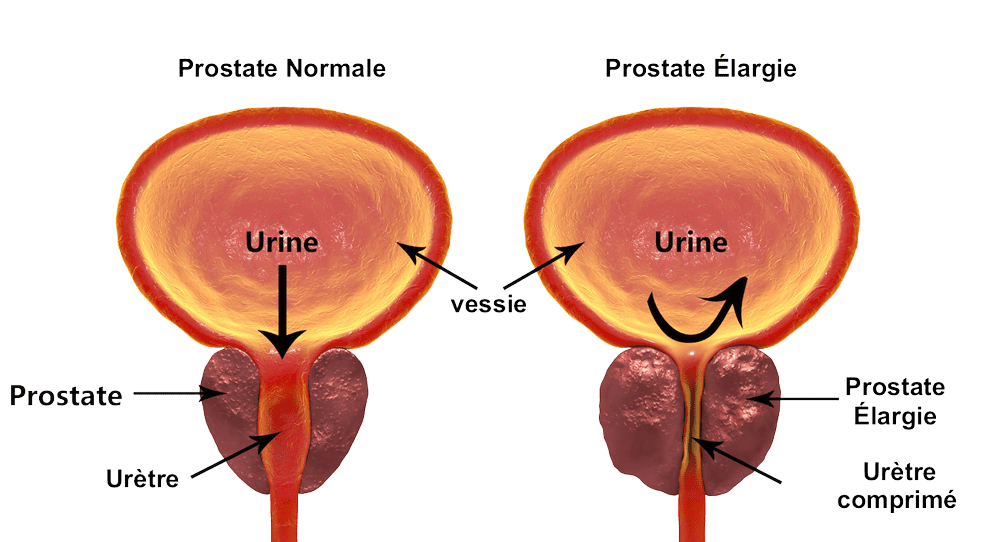
Consequently, the urinary flow rate decreases: the bladder has to push harder to empty itself, and eventually becomes exhausted. The symptoms of'prostate adenoma do not come solely from the gland: they also come from the bladder, which has been compensating for years.
Two prostates of the same volume do not cause the same symptoms. What matters is not the size of the gland, but its impact.
Prostate Center — ParisThe symptoms of prostate adenoma
Urinary disorders related to'prostate adenoma are divided into two groups, which often coexist in the same patient.
Obstructive signs
They translate the mechanical obstacle.
- Weak or interrupted urine stream
- Delay before urination starts
- Need to strain to urinate
- Feeling of incomplete emptying
- Post-micturition drips
Irritative signs
They translate bladder suffering.
- Repeated night awakenings
- Frequent urge to urinate
- Urgent urges difficult to hold back
- Urge incontinence
The intensity of these symptoms is measured by IPSS score, an international questionnaire that quantifies discomfort and makes it possible to monitor its progression over time. It is this questionnaire that demonstrates the effectiveness of a treatment, much more so than measuring prostate volume.
https://adenome-prostate.com/embolisation-prostate/ : prostate symptoms
Causes and risk factors
To date, the exact mechanisms of'prostate adenoma remain partially understood. However, hormonal changes related to male aging, particularly the role of dihydrotestosterone, are considered the primary factor.
- Age — the frequency increases steadily after 50 years of age
- Family medical history — an affected father or brother increases the risk
- Hormonal factors — the androgenic balance changes over the years
Conversely, prostate adenoma is neither a consequence of sexual activity, nor a transmissible disease, nor a precancerous condition. These three misconceptions frequently come up during consultations.
Complications of an untreated prostate adenoma
Evolution is usually slow. In itself, the adenoma is not dangerous: it is its consequences on the bladder and kidneys that make it unwise to wait indefinitely.
- Recurrent urinary tract infections, favored by the residue that stagnates in the bladder
- Bladder stones, for the same reason
- Blood in the urine — never to be trivialized, even if the cause is often benign
- Acute urinary retention — urine is no longer passing at all, an emergency requiring catheterization
- Renal impact — the most serious complication in advanced forms
Do you get up several times a night?
Send us your file: we will tell you which exams are missing and what options are available in your case.
Prostate adenoma or prostatitis?
Both affect the prostate and cause urinary problems. However, they are two different diseases that are not treated in the same way.
| Criterion | Hypertrophy (BPH) | Prostatitis |
|---|---|---|
| Nature | Benign increase in volume | Inflammation, infectious or not |
| Age | After 50 years | At any age |
| Dominant sign | Difficulty urinating, weak stream | Pelvic pain, burning sensation |
| Installation | Gradual, over the years | Often brutal, sometimes feverish |
| Support | Surveillance, medication, minimally invasive techniques, surgery | Treatment of infection or inflammation, pain management |
Finally, the two conditions can coexist. This is why only a clinical examination, supplemented by appropriate tests, makes it possible to tell them apart.
Pre-treatment assessment
Contrary to popular belief, the evaluation is not used to measure the prostate: above all, it serves to assess its actual impact on urination, the bladder, and the kidneys.
- Consultation and IPSS scoreMedical history review, clinical examination, standardized questionnaire quantifying symptom severity and their impact on quality of life.
- Prostate, renal, and bladder ultrasoundMeasurement of prostate volume and post-void residual, and checking for the absence of impact on the kidneys.
- Preoperative arterial CT scanBefore embolization, mapping the arterial network of the prostate makes it possible to prepare the pathway in advance, reduce the duration of the procedure, and limit the risk of non-target embolization.
However, the prostatic arteries are small and vary greatly from one man to another. Mapping them before the procedure makes it possible to anticipate difficulties rather than discovering them during the procedure.
Treatments for prostate adenoma
The management of'prostate adenoma depends on the discomfort experienced, the volume and shape of the gland, the impact on the bladder, and the patient's priorities. Four approaches are possible.
Surveillance and medical treatment
As long as the symptoms remain tolerable and without impact, watchful waiting remains a legitimate option. Afterward, medications—alpha-blockers, 5-alpha-reductase inhibitors—often provide effective relief, but their effect can wear off over time.
Prostatic artery embolization
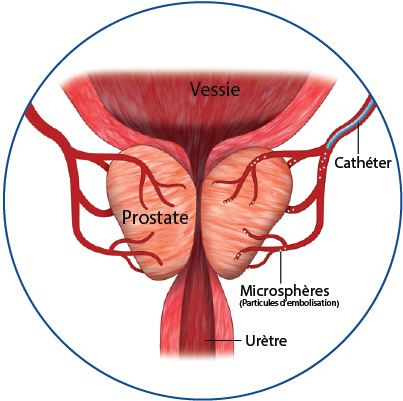
The arteries that supply the prostate are blocked with microparticles, via the arterial route, under local anaesthetic and without incision. The gland gradually decreases in volume over the following weeks, which frees the urethra. Same-day discharge, resumption of activities the very next day, low risk of ejaculation disorders.
Prostate embolization in detail
Rezum and Urolift
The Resume destroys a part of the adenoma using water vapor, with a catheter usually left in place for a few days. The Urolift does not remove tissue: small implants mechanically hold the prostatic lobes apart. These two endoscopic techniques are intended for specific prostate configurations.
Surgery: resection and enucleation
The obstructive tissue is removed endoscopically. It is the gold standard in terms of efficacy on flow rate, at the cost of heavier anesthesia, hospitalization, and a frequent impact on ejaculation.
Frequently asked questions about prostate adenoma
Can a prostate adenoma become cancer?
No. Prostate adenoma and prostate cancer are two distinct diseases that develop in different areas of the gland. Having an adenoma does not increase the risk of cancer. However, the two can coexist, which justifies a clinical examination and a PSA test during the evaluation.
Does an enlarged prostate always cause symptoms?
No. Some men have a very enlarged prostate with no noticeable discomfort, while others suffer a lot with a moderate volume. What matters is the impact on urination and the bladder, not the volume figure.
Should treatment begin as soon as symptoms appear?
Not necessarily. As long as the discomfort remains moderate and there is no impact on the bladder or kidneys, watchful waiting is a legitimate option. Treatment is discussed when quality of life is affected, when medications are no longer sufficient, or when complications arise.
Are nocturnal awakenings always caused by the prostate?
No. They can also result from evening beverage consumption, a sleep disorder, heart failure, or diabetes. This is one of the reasons why the medical evaluation is not limited to the prostate.
Will I need to wear a urinary catheter?
Not in the context of an embolization: our protocol does not require a catheter during the procedure. However, a catheter may be necessary in the event of acute retention, or following certain surgical techniques.
Have your prostate adenoma evaluated
Send your latest urinalysis, ultrasound or MRI if you have one. We will tell you what is missing and what options are available in your situation.
Prostate Center — Blomet Clinic
136 bis rue Blomet, 75015 Paris · Monday to Saturday, 9 AM – 6 PM · +33 6 32 84 14 31
Related pages
Editorial responsibility. Medical content written and validated under the responsibility of Dr. Antoine Hakimé, interventional radiologist. Last medical review: August 2026. The information provided is for informational purposes and does not replace a medical consultation. No results can be guaranteed: any indication requires an individual evaluation.