
Treatment of adenoma
Prostate embolization: the minimally invasive treatment for adenoma
Prostatic artery embolization reduces prostate volume by closing the vessels that supply it. Without an incision, under local anesthesia, on an outpatient basis—and without touching the urethra or the bladder neck, which explains its favorable profile regarding sexual function.
What is prostate embolization?
Definition
L'prostatic artery embolization (EAP), also called prostate artery embolization or prostatic embolization, consists of reducing the volume of the gland by selectively obstructing the arteries that supply it. It is performed by a interventional radiologist, via the arterial route, without surgical opening.
The principle is simple: with less blood supply, the prostate gradually decreases in volume. Consequently, the compression it exerts on the urethra diminishes and urine flows normally again. In other words,'prostate embolization treats the mechanical cause of urinary disorders without removing tissue.
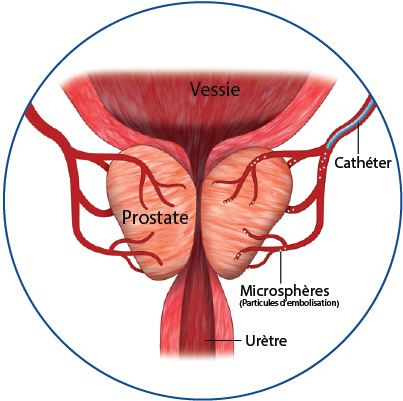
This is what fundamentally distinguishes it from endoscopic and surgical techniques: the latter act from inside the urinary tract, whereas embolization acts from the blood vessels. This difference in the approach explains most of its advantages—and some of its limitations.
Embolization does not go through the urethra. That is precisely why it does not damage it.
Prostate Center — ParisHow does prostate artery embolization take place?
The procedure takes about an hour. In practice, it is broken down into six steps.
- PreparationBiological assessment, prostatic ultrasound, and arterial CT angiography. This preliminary mapping makes it possible to identify the prostatic arteries and anticipate anatomical variations even before entering the operating room.
- Local anesthesiaA simple local anesthetic at the groin crease, or at the wrist in some cases. You stay awake and can talk to the team throughout the procedure.
- Arterial accessA microcatheter is introduced via a skin puncture of a few millimeters, then guided under radiological control to the prostatic arteries.
- Injection of embolization agentsMicrospheres are injected into the targeted arteries. They selectively obstruct the vessels that supply the adenoma, without affecting neighboring territories.
- Real-time controlImaging continuously tracks the distribution of the particles. The catheter is repositioned as many times as necessary to achieve complete and distal embolization.
- Monitoring and releaseA few hours of monitoring, then return home the same evening. No urinary catheter is placed during the procedure in our protocol.
Let's note a point that often surprises patients: the procedure is painless. Indeed, arteries are not innervated, and the'local anaesthetic concerns only the puncture site.
Why embolization preserves sexual function
This is the question that comes up most often in consultation, and it deserves an anatomical answer rather than a commercial promise.
Ejaculation disorders after treatment of the adenoma stem from the destruction of the bladder neck and prostatic urethra. However,'prostatic artery embolization does not intervene on these structures at any time: it acts from within the blood vessels, at a distance from the urinary tract. Consequently, the mechanism that causes retrograde ejaculation after resection is simply not at play.
In practice, this translates to a low risk of ejaculation disorder and by the absence of any documented negative effects on erectile function. By comparison, transurethral resection results in retrograde ejaculation in approximately 80 % of cases.
Namely
Certain medication treatments for the adenoma — 5-alpha-reductase inhibitors, alpha-blockers — can also affect libido, erection, or ejaculation. Therefore, it is not just a matter of surgery.
Follow-up after prostatic embolization
The patient is discharged the same day. Afterwards, moderate discomfort is common for 48 to 72 hours: pelvic heaviness, burning upon urination, and more frequent urges. These symptoms are part of the post-embolization syndrome and subside spontaneously.
The resumption of routine activities takes place the very next day. On the other hand, the improvement of urinary symptoms is progressive: it develops over the weeks as the prostate volume decreases. This is an important difference from surgery, the effect of which is more immediate.
- Urine flow rate — progressive increase as pressure on the urethra is released
- Obstructive symptoms — less effort to start, stronger jet, more complete drainage
- Irritative symptoms - reduction of urgent urges and nighttime awakenings
Is your medical treatment no longer enough?
Send your file. We will tell you if embolization is suitable for your anatomy, and if not, which technique is.
Our technical approach
100 to 300 micron microspheres
Our years of experience have led us to favor particles smaller than those usually employed. This choice allows for a more distal, and therefore more complete, embolization of the prostatic arteries. International literature has since confirmed this direction.
A distal and complete embolization
As the first team to demonstrate that the quality of embolization determines clinical outcome, we have established an objective endpoint criterion for the procedure. All subsequent publications confirm this approach.
The Glue and Microspheres Association
The first team to demonstrate a significant reduction in the risk of recurrence after prostate embolization—to less than 5 %—through the use of adhesive. However, this is a technically demanding procedure that requires extensive experience: very few teams in France currently perform it.
Internal follow-up on the first 100 patients treated, article currently in press. These observations do not prejudge individual outcomes.
Other treatments for prostate adenoma
Embolization is not the only option, and it is not suitable for every situation. Our center performs all three minimally invasive techniques and works with interventional urologists: the choice is therefore based on anatomical criteria, never on the available technique.
Drug treatment
Two families of drugs are used: alpha-blockers, which relax the prostate muscle, and 5-alpha-reductase inhibitors, which slowly reduce the volume of the gland. Their effectiveness is real but can diminish over time. In addition, they carry the risk of side effects: decreased libido, and erectile and ejaculatory disorders for the former; low blood pressure, dizziness, nasal congestion, and digestive disorders for the latter.
Rezum: water vapor
The Rezum procedure injects water vapor directly into the adenoma. The heat destroys the excess cells and the volume decreases over the weeks. The procedure is ambulatory and well tolerated. However, a urinary catheter is usually left in place for a few days, and retrograde ejaculation remains possible since the procedure goes through the urethra.
Learn more about our Rezum technique
UroLift: Prostatic Implants
The Urolift neither destroys nor removes any tissue. Small implants are placed endoscopically to mechanically pull back the prostatic lobes and clear the urinary tract. Its major advantage lies in the immediate effect, without waiting for volume reduction, and a very favorable profile regarding ejaculation. On the other hand, the technique is intended for prostates of moderate volume, without a marked median lobe: beyond that, it loses effectiveness.
Transurethral resection of the prostate (TURP)
TURP removes the obstructing tissue endoscopically. It remains the gold standard for improving urinary flow. However, it requires general anesthesia or spinal anesthesia, a hospital stay of two to seven nights, a urinary catheter for 24 to 72 hours, and results in retrograde ejaculation in approximately 80 % of cases.
Comparison of the four techniques
No technique is superior across all criteria. Here is what each brings, and what it costs.
| Criterion | Embolization | Resume | Urolift | RTUP |
|---|---|---|---|---|
| First approach | Arterial | Endoscopic | Endoscopic | Endoscopic |
| Anesthesia | Locale | Local or mild | Local or mild | General or spinal |
| Hospitalization | Outpatient | Outpatient | Outpatient | 2 to 7 nights |
| Urinary catheter | Unasked | A few days | Rare, brief | 24 to 72 hours |
| Retrograde ejaculation | Low risk | Possible | Low risk | Approximately 80 % |
| Time to effect | Progressive, a few weeks | Progressive, a few weeks | Immediate | Fast after healing |
| Prostate volume | Suitable for prostates over 40 g | Moderate volume | Moderate volume, no median lobe | Wide range |
| Main limit | Depends on arterial anatomy | Postoperative catheter | Do not reduce the volume | Sexual impact and recovery |
Data from international literature and the center's experience. Each indication remains individual and is determined after evaluation.
At what volume is intervention necessary?
Prostate volume is measured by ultrasound or MRI. Beyond 30 to 40 cubic centimeters, it is considered a significant increase. However, this figure alone does not determine anything.
Indeed, some patients present a median lobe which obstructs the bladder neck even though the prostate remains small in volume. Conversely, a large prostate can remain well tolerated for a long time. Therefore, it is the impact that determines the indication, not the size.
The situations that lead to treatment are as follows:
- Severe urinary symptoms impacting quality of life
- Medical treatment has become insufficient or poorly tolerated
- Urinary retention, acute or chronic
- Recurrent urinary tract infections
- Significant post-void residual or impact on the kidneys
Frequently asked questions about prostate embolization
Is prostatic embolization painful?
The procedure itself is painless: the arteries have no nerve supply and only the puncture site is numbed. Afterwards, pelvic discomfort or a burning sensation when urinating may occur for 48 to 72 hours, and then fade away.
Is an enlarged prostate cancer?
No. The'benign prostatic hyperplasia is a non-cancerous increase in the volume of the gland, linked to aging. It does not develop into cancer and does not increase the risk of it. However, both can coexist, which justifies measuring the PSA during the review.
Do the results of embolization last over time?
Follow-up studies show sustained improvement over several years. However, recurrence remains possible, linked to the natural revascularization of the gland. This is precisely what the combination of glue and microspheres aims to limit.
Can an embolization be performed after another treatment?
Yes in most cases, including after failure of medical treatment or an endoscopic technique. The arterial anatomy is then evaluated by angioscanner, as with any embolization.
Am I a good candidate for embolization?
That depends on prostate volume, gland configuration, the condition of your arteries, your symptoms, and your priorities. That is the purpose of the initial assessment: to tell you honestly whether embolisation is the right option, and if not, which one is.
Get your indication evaluated
Send your urinary diary, your ultrasound, your latest PSA test, or your MRI if you have one. We will tell you what is missing and what techniques are possible in your case.
Prostate Center — Blomet Clinic
136 bis rue Blomet, 75015 Paris · Monday to Saturday, 9 AM – 6 PM · +33 6 32 84 14 31
Related pages
Editorial responsibility. Medical content written and validated under the responsibility of Dr. Antoine Hakimé, interventional radiologist. Last medical review: September 2026. The information presented is for informational purposes and does not replace a medical consultation. No results can be guaranteed: any therapeutic indication requires an individual evaluation.