
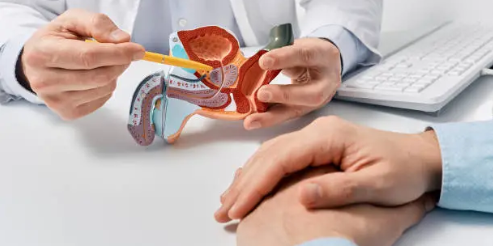
An enlarged prostate
More than a third of men over 50 have an enlarged prostate, which can make it harder to urinate.
Medication or surgery can help, but the National Institute for Health and Care Excellence believes that men should now be offered another treatment option.
PAE (prostatic artery embolization) can be performed under local anesthesia, which means patients can go home shortly afterward without having to be hospitalized, unlike traditional prostate surgery.
Doctors pass a small tube through an artery in the groin, which can be guided into the small blood vessels of the prostate.
Prostate treatment in the UK
In the UK, some 20 centers already offer prostate embolization treatment.
Dr Nigel Hacking, interventional radiologist and consultant at University Hospital Southampton, said: "It is a particularly attractive option for men who are not yet ready to undergo more invasive prostate surgery. Maintaining sexual function and fertility is one of its key benefits."
Why did the United Kingdom become interested in prostatic embolization?
Benign prostatic hyperplasia is particularly common with age.
When the prostate enlarges, it can compress the urethra and cause various urinary problems:
- a weak urine stream ;
- difficulty starting to urinate; ;
- frequent urges to urinate; ;
- night wakings ;
- a sensation of incomplete bladder emptying; ;
- sometimes urinary retention.
When medications are no longer sufficiently effective or are poorly tolerated, an intervention may be considered.
For a long time, the main solutions relied on surgical or endoscopic treatments, notably transurethral resection of the prostate (TURP).
Embolization offers a different approach: treating the prostate through the arteries, without introducing a surgical instrument into the urethra.
What does NICE actually say about embolization?
NICE is the UK body responsible for evaluating, among other things, the efficacy and safety of many treatments used in the healthcare system.
Her recommendations regarding prostatic artery embolization indicate that the evidence concerning the safety and efficacy of the procedure is sufficient to allow its use within the standard care setting, provided that the rules of consent, clinical governance, and follow-up are respected.
This position is important because it shows that embolization is no longer considered a purely experimental technique.
Several NHS facilities now offer this procedure to patients with an enlarged prostate. British hospitals such as Royal Free London or University College London Hospitals present it as a minimally invasive alternative to certain prostate surgeries.
A non-surgical prostate procedure
One of the particularities of embolization is that it does not require a prostate incision.
It also does not involve resection of the prostatic tissue through the urethra.
In several NHS facilities, the procedure is described as a non-surgical treatment that can be performed on an outpatient basis or with a short stay in the hospital.
The procedure is generally performed under local anesthesia.
Recovery is therefore often faster than after certain traditional surgical procedures.
What are the desired benefits?
For some patients, embolization has several attractive features:
- absence of surgical incision of the prostate ;
- intra-arterial treatment ;
- usually local anesthesia; ;
- frequent short hospital stay; ;
- relatively quick recovery; ;
- limited risk of certain sexual side effects; ;
- possibility of treating certain very large prostates.
Information documents from several British institutions highlight in particular the favorable profile of embolization regarding ejaculation, incontinence, and sexual function compared to certain surgical techniques.
However, this does not mean that the risk is zero or that embolization is preferable in all situations.
Which patients can be offered embolization?
Embolization may be considered in certain men presenting with symptomatic benign prostatic hyperplasia, especially when medications no longer sufficiently control the symptoms.
It may also be of interest to certain patients:
- showing an enlarged prostate; ;
- wishing to avoid a transurethral procedure; ;
- concerned about certain sexual side effects; ;
- presenting with significant urinary symptoms despite medical treatment.
However, the decision must be made after a complete assessment.
The evaluation takes into account, among other things, prostate volume, arterial anatomy, symptoms, urinary flow rate, and bladder condition.
Some patients are not good candidates for embolization, particularly in the presence of certain vascular anomalies or associated pathologies.
Embolization or surgery: two different approaches
Embolization does not systematically replace prostate surgery.
Endoscopic techniques such as TURP or HoLEP remain particularly effective and may be preferable in certain situations.
Embolisation is distinguished above all by its nature minimally invasive and by the absence of direct treatment through the urethra.
The choice therefore depends on several criteria:
- prostate volume ;
- the importance of the obstruction; ;
- urinary symptoms ;
- the condition of the bladder ;
- treatments already performed; ;
- the patient's priorities regarding recovery and sexual function.
The discussion between the patient, the urologist, and the interventional radiologist helps determine the most appropriate option.
A technique now used in several British hospitals
Several NHS facilities now have dedicated information on prostate embolisation.
Royal Free London presents it as a minimally invasive technique for treating BPH by blocking the small blood vessels supplying the prostate. University College London Hospitals also describes it as an alternative to TURP or certain laser procedures.
This integration into various British hospital facilities shows that prostatic embolization is now part of the therapeutic options offered to certain patients.
In summary
L'prostatic artery embolization is recognized in the United Kingdom as a treatment option for benign prostatic hyperplasia.
NICE considers the available data concerning its efficacy and safety sufficient to allow its use in clinical practice, with appropriate patient selection.
This minimally invasive technique allows for the gradual reduction of prostate volume via the arterial route, without surgical incision or resection of prostate tissue through the urethra.
It can thus constitute an interesting alternative for certain men presenting with urinary symptoms related to BPH.
To know if prostate embolization can correspond to your situation, a personalized assessment allows for the evaluation of your prostate, your symptoms, and your arterial anatomy before discussing the various treatment options.