
Prostate Center
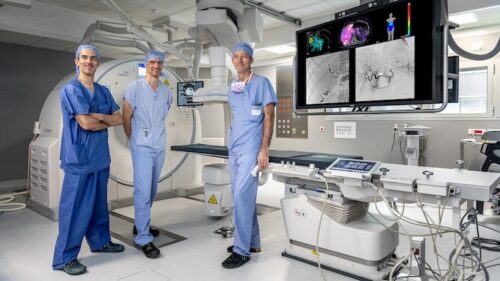
15 years that we practice prostate artery embolization, and more 3000 patients treated: this is one of the largest experiences in France. Our interventional radiologists are experts in this procedure, which they have been performing every week since its inception in France. And they continue to find and document areas for improvement choice of particles and glue, catheterization precision, embolization quality criteria.
Pioneers prostate embolization.
L'prostate artery embolization process it'adenoma without an incision, under local anesthesia and on an outpatient basis. It is also, to date, the only technique that preserves sexual function so well: the risk of ejaculation disorders remains very low, whereas surgery carries a massive risk.
Our experience
Internal center data, unpublished, supplemented by international literature. Results vary from patient to patient and cannot be guaranteed.
Are you looking for an answer to
Three situations, three journeys.
Adenoma and urinary disorders
Nocturnal awakenings, weak stream, bladder that does not empty completely, medical treatment has become insufficient.
See embolization 02 — DiagnosticSuspected cancer
Elevated PSA, MRI to be interpreted, biopsy discussed. Embolization does not treat cancer: diagnosis comes first.
View the diagnostic pathway 03 — PainsChronic prostatitis
Persistent pelvic pain, burning sensation, repeated episodes despite antibiotics.
See optionsA simple life after the intervention
The benefits of prostate embolization.
Specifically, here is what prostatic embolization helps preserve, and what it changes in the days following the procedure.
Prostatic embolization
However, embolization is not indicated for all anatomies. This is why the indication is determined after a consultation, ultrasound, measurement of prostate volume, and evaluation of your priorities.
The foundational 2021 article
First team to demonstrate that the quality of embolization determines the outcome: to be effective, it must be distal and complete. All subsequent publications confirm this approach.
Using prostate contrast retention (PCR) as the procedural endpoint in prostatic artery embolization for benign prostatic hyperplasia. European Radiology, 2021;31(12):9150-9160. PubMed
On the day of the procedure
Prostate embolization lasts one hour. You go in the morning, and by evening you are home.
In practice, the procedure is performed by an interventional radiologist on a vascular table and under real-time guidance. Here is how it unfolds, step by step.
A simple local anesthesia at the groin crease, or at the wrist in some cases. No general anesthesia: you remain awake and can talk to the team throughout the procedure.
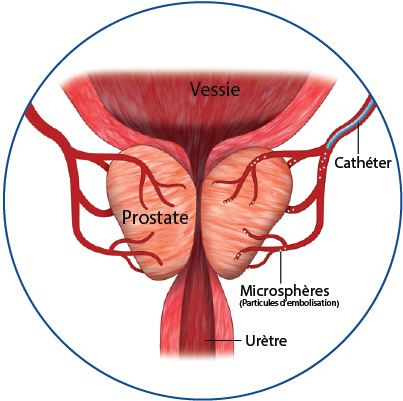
A microcatheter is guided through the vessels to the arteries supplying the prostate under real-time imaging. No pain: the arteries are not innervated.
Particles ranging from 100 to 300 µm are injected to reduce blood supply. We combine glue with the microbeads to limit the risk of recurrence. The gland then gradually decreases in volume over the following weeks, which frees the urethra.
A few hours of monitoring, then return home in the evening. Resumption of routine activities the very next day.
A technique that very few teams master
The first team to demonstrate a significant reduction in the risk of recurrence after prostate embolization—to less than 5 %—through the use of the adhesive.
The addition of glue is a demanding technique that requires significant experience: today, it is practiced by very few teams in France. Internal follow-up on the first 100 patients treated, article in the process of publication. These observations do not prejudge the individual outcome.
Prostate Center Paris
A center entirely dedicated to the prostate, in Paris.
The Center brings together interventional radiologists and interventional urologists specialized in the management of the prostate. More than 3,000 patients have been treated there by embolization, alongside ongoing research on the improvement of techniques.
The team
Interventional radiologists and urologists
A team that masters several minimally invasive prostate techniques and practices them daily. It is this volume that makes it possible to tackle difficult anatomies.
Our specialistsThe search
A documented and published practice
More than 3000 patients treated, works published in European Radiology and the Journal of Personalized Medicine regarding the procedure completion criterion, prostatic arterial anatomy, and technique optimization.
Our studies and publicationsOur science-backed practice
The center's team is publishing on the technique itself: criteria for ending the procedure, arterial anatomy, difficulties, and prospects for prostatic embolization.
Prostate Artery Embolization: Challenges, Tips, Tricks, and Perspectives. Journal of Personalized Medicine, 2022;13(1):87. PubMed
Center news
Our work on prostatic embolization.
Technique · Surgical approach
Direct percutaneous puncture of the prostatic artery
An approach developed at the center for anatomies in which classic arterial catheterization fails. A study involving 30 patients referred after the failure of conventional prostatic embolization, with successful revision in virtually all cases in this series.
Read the studyTechnique · Embolization agents
100–300 µm microspheres: more precise embolization
The center is one of the few in France to advocate for the use of small particles. A review of the literature confirms their value, with a reported recurrence rate lower than with larger-caliber particles.
Read the scientific article on PubMedResults · Sexual function
Embolization and sexual function
Comparison of the different treatment techniques for prostate adenoma with regard to their sexual consequences. Unlike resection techniques, prostatic artery embolization has no documented negative effect on erection, and the risk of ejaculation disorder is low.
Read the articleResults · CEAP Study
CEAP study: 124 patients treated by embolization
Our first series study reports 96 % cases with results deemed highly satisfactory, with no major complications reported in this cohort. It forms the basis for our experience, which now encompasses more than 3,000 patients.
Read the studyHave you come a long way?
Two formats designed for a single trip.
France · One day
One Day Check-up
The complete assessment grouped into a single visit: consultation, ultrasound, reviewed imaging, cross-opinions, and explained strategy.
- Your exams are analyzed before your arrival
- Only missing exams are scheduled
- Decision discussed the same day
International · one week
One Week Prostate
Assessment, procedure, and follow-up organized during the same stay in Paris, with administrative and logistical support.
- File reviewed remotely before departure
- Assessment and intervention in the same week
- Organized follow-up after return
- Paris MatchThe adenoma treated by embolization
- Interventional NewsSymptom improvement after PEA
- NICE — UKRecommendation for embolization
- PubMedSuperiority of small particles
Frequently asked questions
What patients ask before prostatic embolization.
Why didn't my urologist mention this to me?
Embolization is performed by interventional radiologists, not urologists. Its widespread adoption remains uneven depending on the region and the practices of each team. This does not prevent it from being recommended today by NICE in the United Kingdom and documented by solid literature.
Is the procedure painful?
It is performed under local anesthesia and remains painless during the procedure: the arteries have no nerve supply. Afterward, some patients experience pelvic discomfort or temporary urinary burning, which disappears in a few days.
Is there any risk to erection or ejaculation?
The risk of ejaculation disorders after embolization is low, significantly lower than that observed after surgical resection. No negative effect on erection has been documented.
Do the results last over time?
Follow-up studies show that improvement is sustained for several years. Recurrence remains possible, due to the gland’s natural revascularization. It is precisely to limit this phenomenon that we combine an adhesive with the microspheres. Our internal follow-up data, based on the first 100 patients treated in this manner, puts the risk of recurrence at less than 5 %. These are internal data; the article is currently being published, and these findings do not guarantee individual outcomes.
Am I a good candidate?
This depends on your prostate volume, the anatomy of your arteries, your symptoms, and your priorities. That is precisely the purpose of the consultation and the preliminary assessment: to tell you honestly whether embolization is the right option for you.
What is the success rate of prostate embolization?
International studies estimate the success rate to be between 80 and 90 %. This improvement is reflected in increased urinary flow, fewer nighttime bathroom visits, and a reduction in the sensation of incomplete bladder emptying. It occurs gradually over the weeks following the procedure.
Does embolization reduce the size of the prostate?
Yes. By reducing blood flow to the gland, embolization causes a gradual decrease in its volume, which relieves the compression on the urethra. The international literature reports a reduction of 20 to 40 %; in our experience, it reaches 50 to 60 % in the months that follow.
How long does the recovery take?
The patient goes home the same day and resumes normal activities the very next day. Urinary comfort, on the other hand, improves gradually over the month following the procedure.
What symptoms may appear after the procedure?
Pelvic discomfort, transient urinary burning, and mild fatigue are common within 48 to 72 hours. These symptoms are part of the post-embolization syndrome and resolve spontaneously.
Is prostate embolization a safe technique?
Major complications are rare when the procedure is performed by a team specialized in interventional radiology. The reported effects are most often temporary urinary irritation, a burning sensation during urination, or transient pelvic discomfort. The precision of the procedure relies on imaging, which makes it possible to target the prostatic arteries and control the distribution of the microspheres.
To go further
Prostate embolization in detail
Definition, procedure, indications, and differences with adenoma surgery.
What is prostate embolization?
L'prostatic artery embolization (EAP), also called prostate artery embolization or prostatic embolization, is a minimally invasive interventional radiology technique used to treat'benign prostatic hyperplasia (HBP), also known as'prostate adenoma. It consists of reducing the volume of the gland by selectively blocking its blood supply, using micro-particles injected into the prostatic arteries under radiological guidance. Performed on an outpatient basis by an interventional radiologist, it is an alternative to surgery for treating urinary problems related to an enlarged prostate, with the advantage of preserving sexual and urinary functions and offering a rapid recovery.
How does the procedure take place?
The patient is positioned on a state-of-the-art vascular table, which allows visualization of all the arteries. The interventional radiologist applies a local anesthetic to the groin or, more rarely, the wrist. Thanks to the experience gained in the center, the placement of a urinary catheter is no longer necessary during the procedure.
A catheter is then inserted into the femoral artery, at the thigh, or the radial artery at the wrist. It is guided through the blood vessels to the prostatic arteries, where small embolization particles are injected to reduce blood flow to the gland. With less blood supply, the prostate gradually decreases in volume: compression of the urethra eases and urine passes more easily.
Embolization or adenoma surgery?
L'prostatic embolization and surgical or endoscopic techniques pursue the same objective: to relieve the obstruction caused by the prostate adenoma. They simply do not take the same path.
Embolization is performed via the arterial route, under local anaesthetic, incision- and scar-free. The patient is discharged the same day and resumes their normal activities the following day. The risk of retrograde ejaculation is low, and no negative effects on erection have been documented. The improvement in urinary symptoms is gradual and sets in over the following weeks.
The choice between these approaches depends on prostate volume, arterial anatomy, medical history, and the patient's priorities. It is discussed during a consultation, following an evaluation, and is part of a shared decision-making process between the patient and their managing physicians.
Rezum, Urolift: other minimally invasive treatments for prostate adenoma
Embolization is not the only minimally invasive alternative to surgery for'prostate adenoma. Two techniques are currently performed endoscopically and can be discussed depending on the patient's anatomy and priorities.
The Resume It consists of injecting water vapor into the prostatic tissue. The heat destroys part of the adenoma, the volume of which gradually decreases over the following weeks. The procedure is performed under local or light anesthesia, and a urinary catheter is usually left in place for a few days.
L'Urolift no tissue is removed: small clips are placed to mechanically pull apart the prostate lobes and clear the urinary channel. The effect is immediate, but the technique is primarily intended for prostates of moderate volume, without a marked median lobe.
These two approaches share with embolization the objective of preserving sexual functions. They differ in their approach—endoscopic rather than arterial—and in the anatomies for which they are suitable. The Prostate Center mastering several minimally invasive techniques: the choice is made after an evaluation, based on prostate volume, gland configuration, and patient expectations.
Make an appointment
Tell us where you stand.
Send your latest urine test, ultrasound, or MRI if you have one. We will tell you what is missing and whether embolization is useful in your case.
- Phone+33 6 32 84 14 31
- E-mailadmin@adenome-prostate.com
- AddressProstate Center — Blomet Clinic
136 bis rue Blomet
75015 Paris - From abroadOne Week Program with dedicated support